24/7 emergency plumbing services: Text name, address and pictures to +1 (236) 233-9696

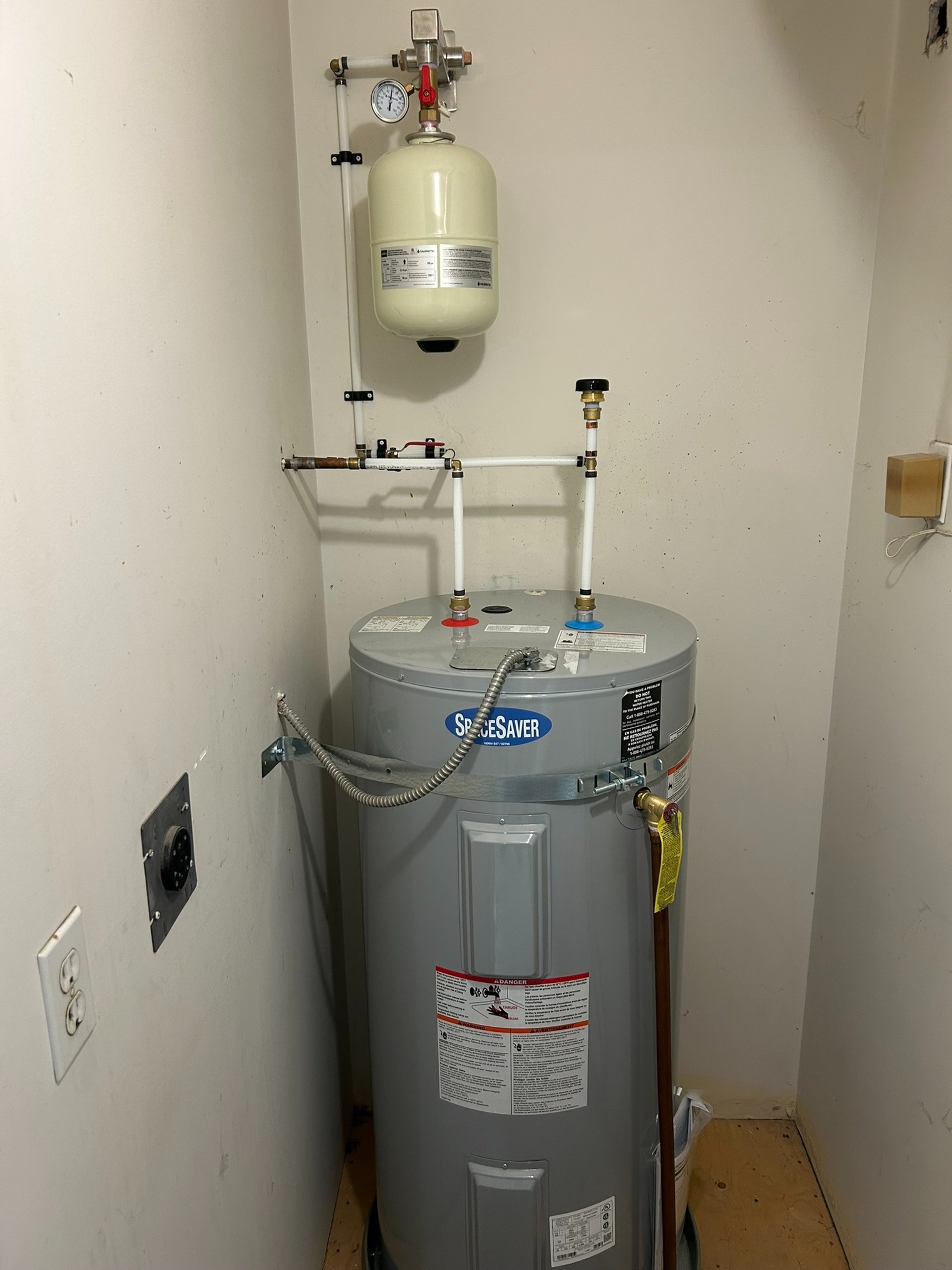
Hot Water Tank Replacement & Installation in Langley
Hot water tank replacement, new installation, repairs and tankless upgrades across Langley. Licensed, insured, Red Seal certified, available 24/7, and no call-out fee.
Call (236) 233-9696 or request a quote below.
Hot Water Tank Replacement
Most tanks in Langley homes get replaced somewhere between year eight and year fifteen. Sometimes that's a decision you make on your own schedule. Sometimes the tank makes it for you at six on a Sunday morning.
A standard replacement is a same-visit job in most cases. We isolate and drain the old tank, disconnect and remove it, set and level the new unit, reconnect water and gas or electrical, fit or replace the expansion tank and temperature and pressure relief line as required, refill, purge the air out of the lines, and verify thermostat operation and recovery before we leave. Seismic strapping goes back on to code.
We size the replacement to your household rather than defaulting to whatever was sitting there before. A 40-gallon tank that worked for a couple becomes a daily argument for a family of five, and an oversized tank quietly leaks money as standby loss for the next twelve years.
If you're trying to work out whether you're due, we've written about how long a hot water tank lasts in Langley and what shortens it.
Hot Water Tank Installation
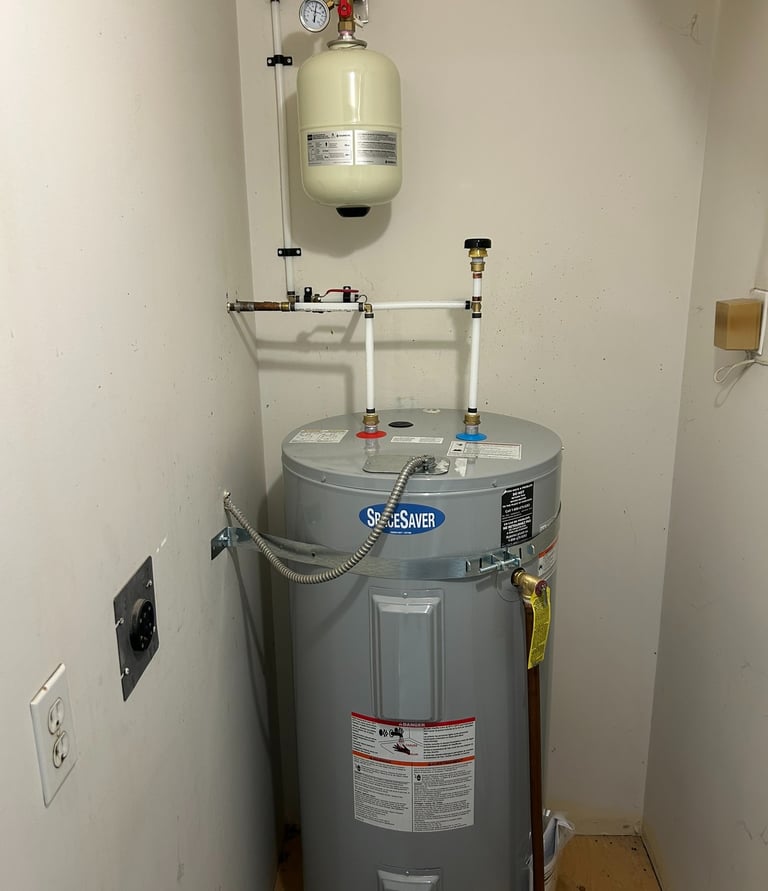
New installations are a different job from replacements. A suite conversion, a basement build-out, a shop or garage, or a first tank in a space that never had one - each brings venting, combustion air, relief line drainage, electrical capacity and clearance requirements that a straight swap doesn't.
We handle the whole install: location and clearance assessment, venting design and installation, gas line sizing and connection under licensed gas fitting, electrical coordination where required, expansion tank, drain pan and relief line routing, and full commissioning.


Benefits Of Tankless On Demand Water Heaters
Many people ask whether it's worth upgrading from a traditional water heater to a tankless model. While tankless systems aren't right for everyone, they offer several advantages, including energy efficiency, longer lifespan, unlimited hot water, and space savings.
Tankless water heaters are up to 34% more efficient than traditional water heaters, so you can save hundreds of dollars every year on your energy bills. Plus, they last twice as long as traditional water heaters, so they're a better value for your money.
Energy Efficiency
Benefits of a Tankless Water Heater Installation
Longer Lifespan
While we're on the subject of saving money, it's worth noting that tankless water heaters last twice as long as traditional systems. So, although they cost more upfront, they're a better value for your money.
Unlimited Hot Water
Families with high hot water demands often run out of hot water too quickly. If you're one of them, a tankless water heater might be right for you. Tankless water heaters don't rely on a storage tank, so you get an unlimited supply of hot water for as long as you need it.
Space Savings
If you’ve used a storage-tank water heater, you know how much space they take up. Tankless water heaters are wall-mounted, allowing you to reclaim usable floor space.
As mentioned, tankless water heaters aren’t suitable for every application but call Plumblink Plumbing Inc. today, if you’d like more information and discuss your options.


Signs Your Water Tank is on it's way out
Rust-coloured or metallic-tasting hot water - the tank lining has failed
Rumbling or popping during heating, caused by sediment on the tank bottom
Hot water running short before it used to, often sediment or a failing element
Water pooling at the base - see the next section, this one is urgent
Moisture, rust or corrosion at fittings or on the tank shell
A tank past ten years old, whatever it looks like
If you're getting less hot water rather than none, that's often a separate fault worth diagnosing properly - see running out of hot water in Langley.


A leaking Tank is an Emergency
Water pooling around the base means the tank body itself has corroded through. There is no repair for that, and it doesn't stay a slow leak. A tank weeping today can let go entirely.
Right now: shut the cold water supply valve at the top of the tank. Cut power at the breaker for an electric unit, or turn the gas control to off for a gas unit. Then call us.
Don't wait for business hours. We're available 24/7, and there's no call-out fee. If you can see water but can't tell where it's coming from, that's a job for leak detection before anything gets replaced.
Repair or Replace?
Worth repairing: a failed thermocouple or igniter, a burnt-out heating element, a faulty thermostat, a gas control valve on a newer unit, a leaking relief valve or fitting, a depleted anode rod.
Not worth repairing: any leak from the tank body. The shell has corroded through and it can't be patched.
The grey area: a tank past ten years needing a significant part. Spending a few hundred dollars on a unit that owes you two more years rarely adds up. We'll tell you which situation you're in before any work starts, not after.


Tankless & Hot Water on demand
A tankless unit heats water as it flows rather than keeping a tank hot around the clock. We install, service and descale them across Langley.
Energy efficiency.
Tankless units are typically 24 to 34% more efficient than a storage tank for households using around 150 litres a day or less. Higher-demand homes see a smaller gain, closer to 8 to 14%. Either way there's no standby loss, because you're not reheating a tank of water nobody is using.
Longer lifespan.
A well-maintained tankless unit commonly runs twenty years or more, against eight to twelve for a storage tank. The up-front cost is higher; the service life is roughly double.
Continuous hot water.
No storage tank means no capacity ceiling. Households that regularly run out mid-shower get the most from this.
Floor space.
Tankless units are wall-mounted, which gives you back the footprint a storage tank occupies.
The honest trade-offs.
Tankless costs more to install, particularly when the gas line needs upsizing and new venting has to be run. It needs descaling roughly annually, which people forget until the unit starts short-cycling. And it's a poor fit as a like-for-like emergency swap on a Sunday - if your tank has just failed, a same-day tank replacement is usually the better call, and we'll say so rather than upselling.
Tank or Tankless?
A tank is cheaper up front, simpler to service, and the right answer for most Langley households.
Tankless makes the most sense when you're already opening up the space, when your household regularly exhausts a tank, or when floor space is genuinely tight.
Going from tank to tankless means new venting plus gas or electrical work, so the install cost is meaningfully higher than a swap.
Call and describe the household - it's a ten-minute conversation that saves money either way.
Code requirements in BC
Two numbers worth knowing. BC requires hot water to be stored at 60°C to control bacterial growth, and delivered to fixtures at no more than 49°C to prevent scalding. Meeting both means a mixing valve on most residential installations, and a missing mixing valve is one of the more common faults we find on older or owner-installed tanks.
Gas water heaters are regulated work. Only a TSBC-licensed gas fitter can perform and permit them. Straight like-for-like residential swaps are generally handled under Technical Safety BC's replacement appliance process; anything beyond that - tank to tankless, a venting change, electric to gas - needs a full installation permit. Electric tanks need a licensed electrician for the connection. We handle licensing and paperwork on every install.


What does it cost?
Cost depends on tank size and fuel type, whether venting or gas line work is involved, access to the installation location, and whether code items like a mixing valve or expansion tank need bringing up to current requirements.
We publish our labour rates and we quote the job rather than a range that moves once we're in your basement. No call-out fee.
Request a quote or call (236) 233-9696.
Hot Water Tank Reviews
Read our client experiences with our plumbing services and solutions.
Frequently asked questions
How long does a hot water tank last?
Most standard tanks last about eight to twelve years. Tankless units often run twenty years or more with regular servicing. Age matters more than appearance - if yours is past the ten-year mark, it's worth planning a replacement before it fails rather than after.
Should I repair my hot water tank or replace it?
Repair usually makes sense if the tank is under eight years old and the fault is a part - a thermostat, heating element, thermocouple, or the temperature and pressure relief valve. If the tank itself is leaking from the body, the shell has corroded through and it can't be patched. That's a replacement. We'll tell you which one you're looking at before any work starts.
Tank or tankless which one is right for my home?
A tank is cheaper up front, simpler to service, and fine for most households. Tankless gives you continuous hot water, uses less energy, lasts longer and frees up floor space, but it costs more to install, and going from tank to tankless means new venting plus gas or electrical work. Larger families and homes that regularly run out of hot water get the most out of it.
How quickly can you replace a tank?
We're available 24/7, and in most cases a failed or leaking tank can be swapped the same day. If yours is actively leaking, shut off the water supply to the tank and cut the gas or breaker, then call us - that limits the damage while we're on the way.
Does a hot water tank need maintenance?
Yes, and almost nobody does it. Draining a few litres from the tank annually clears sediment that otherwise insulates the bottom of the tank and shortens its life. The anode rod, which sacrifices itself to protect the tank lining, should be checked around year five and replaced when depleted - it's the single cheapest thing you can do to extend tank life. Tankless units need descaling roughly annually, more often on hard water.
Do I need a permit to replace a hot water heater?
Gas water heaters are regulated work - installation has to be done by a licensed gas fitter, and straight like-for-like residential swaps are generally covered under Technical Safety BC's replacement appliance process. Anything beyond a like-for-like swap needs a full installation permit: tank to tankless, a venting change, or electric to gas. Electric tanks need a licensed electrician for the connection. We handle the licensing and paperwork on every install.
What size of hot water tank do I need?
For most Langley homes it comes down to household size and bathroom count. A 40-gallon tank suits one to three people, 50 gallons is the common choice for a family of three or four, and larger households or homes with a soaker tub often need 60 gallons or more. If you're switching to tankless, sizing is based on flow rate rather than capacity - how many fixtures you need running at once.
Get a Hot Water Tank Quote
Looking to get started with a quote for your next hot water tank project?
Please fill in the form to schedule your quote.
24/7 emergency plumbing services. Give us a call anytime and we'll be there to help.
Langley, BC, Canada
Plumblink Plumbing Inc.