24/7 emergency plumbing services: Text name, address and pictures to +1 (236) 233-9696

Hot Water Tank Lifespan Langley BC: How Long Do Tanks Last?
A Hot water tank lifespan Langley BC homeowners can expect: 8–12 years. Warning signs of failure, why local water shortens tank life, and when to replace.
HOT WATER
Plumblink Crew
7/25/20265 min read


Hot water tank lifespan in Langley BC: How long do tanks last?
Nobody thinks about their hot water tank until the shower goes cold - or worse, until there's water spreading across the utility room floor.
By then you're not making a decision, you're reacting to one.
The good news: a failing tank almost always gives you warning.
Here's what a hot water tank should last in a Langley home, what shortens that lifespan locally, and the signs that mean you've got months rather than years.
The short answer: 8 to 12 years
A standard gas or electric storage tank installed in a Langley home typically gives you 8 to 12 years of service.
Well-maintained units on softer water can push past 12. Units that have never been flushed, or that sit on a high-mineral supply, sometimes fail at 6 or 7.
Tankless (on-demand) systems are a different story - properly maintained, they commonly run 15 to 20 years, which is a large part of why homeowners consider the switch when their tank finally goes.
Don't know how old yours is?
Check the serial number on the manufacturer's label.
Most brands encode the manufacture date in the first four characters — often as month and year, or a letter for the month followed by the year.
If your tank is over 10 years old, it's not an emergency, but it should be on your radar and it should not be ignored on a pre-listing home inspection.
Why Langley tanks often don't hit the top of that range
Water chemistry is the biggest variable in tank lifespan, and it varies more across the Fraser Valley than most homeowners realize.
A good portion of Langley's supply is drawn from local groundwater aquifers rather than the mountain reservoir water that serves much of Metro Vancouver.
Groundwater carries more dissolved calcium and magnesium.
What that means inside your tank:
Sediment builds faster.
Minerals drop out of solution as water heats and settle on the tank bottom, forming an insulating crust between the burner and the water.
Your burner works harder.
That crust means longer heating cycles, higher gas or hydro bills, and more thermal stress on the steel.
The anode rod sacrifices itself faster.
That rod exists to corrode instead of your tank lining.
Once it's spent - often around the 5-year mark on harder water - the tank itself starts rusting from the inside.
The fix isn't complicated.
An annual flush and an anode rod check partway through the tank's life can add years to it. Skipping both is the single most common reason a Langley tank dies early.
7 signs your tank is on its way out
1. Rusty or discoloured hot water.
If the rust shows up only on the hot side, the tank lining is failing. (If it's on both hot and cold, you may be looking at a supply pipe issue instead - that's a repiping and water line conversation.)
2. You're running out of hot water sooner than you used to.
Same household, same habits, shorter showers. That's usually sediment eating your usable tank volume.
Usually - but not always. A cracked dip tube, a dead element or a crossed shower valve produce the same symptom on a perfectly healthy tank, so it's worth ruling those out first: why you're running out of hot water.
3. Rumbling, popping, or crackling during a heating cycle.
That's water boiling underneath the sediment layer. It's the sound of a tank in its final chapter.
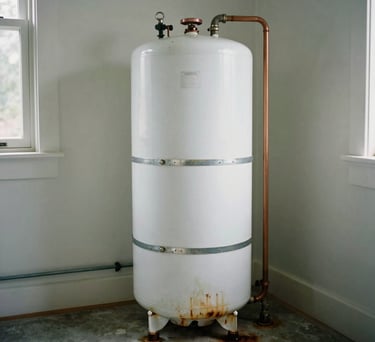
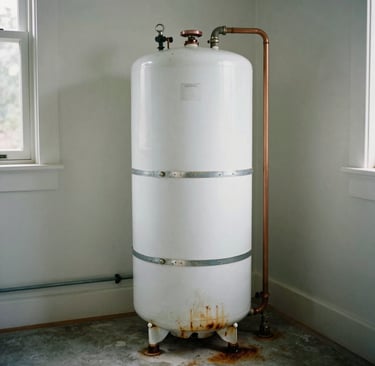
4. Moisture, rust streaks, or mineral crust around the base.
A tank that weeps before it bursts is doing you a favour. Don't ignore it.
5. The temperature swings.
Hot, then lukewarm, then hot again often points to a failing thermostat or element - sometimes a cheap repair, sometimes the first sign of bigger problems.
6. The relief valve is discharging.
The T&P valve is a safety device. If it's letting go, either it's failed or your pressure and temperature are genuinely too high. Either way, get eyes on it.
7. It's past 12 and you've never had it serviced.
Age alone isn't a death sentence, but age plus zero maintenance is a coin flip you're making every day you leave it.
Repair or replace?
A rough rule that holds up well: if the unit is under 8 years old and the problem is a component - thermocouple, thermostat, element, valve - repair is usually the smart money. If it's over 10 and the tank itself is leaking, replacement is the only real option. A leaking tank body can't be repaired; the steel is compromised.
The in-between years are a judgement call, and it should be an honest one.
We'll tell you when a repair buys you real time and when it's just delaying a replacement you'll pay for anyway.
What a proper replacement includes in BC
Not all installs are equal, and the difference shows up years later. A code-compliant hot water tank replacement in Langley should include:
Seismic strapping - required in BC, and frequently missing on older installs
A correctly sized expansion tank where the system is closed
Proper venting and combustion air for gas units
A drain pan and drain line where the unit sits above finished space
A permit and inspection where the municipality requires it
Old unit hauled away and recycled
If you're getting quotes, ask what's included. A number that looks lower usually is lower because something on that list came off it. We put it in writing - see upfront quotes and pricing.
Should you switch to tankless while you're at it?
Replacement is the natural moment to consider it, because most of the labour overlaps. Tankless makes sense when:
Your household regularly runs out of hot water
You want the floor space back
You're planning to stay in the home long enough for the efficiency to pay you back
Your gas line and venting can support it (this is the part that decides it — undersized gas lines are the most common reason a conversion costs more than expected)
It makes less sense in a low-demand home with a tight mechanical space and a gas service that would need upgrading. We'll tell you straight which side you fall on. More detail on both options: hot water tanks and hot water on demand in Langley.
Three things you can do this weekend
1. Find the manufacture date on the label and write it somewhere you'll find it again.
2. Check the base with a flashlight and a dry paper towel. Any moisture is worth a call.
3. Book a flush if it's been more than a year - or ever.
Talk to a Red Seal plumber in Langley
Plumblink Plumbing Inc. installs, services, and replaces hot water tanks and tankless systems across Langley, from Willoughby and Walnut Grove to Murrayville, Brookswood and Aldergrove. Red Seal certified, straightforward first-hour rate, no surprise fees, and 24/7 for emergencies.
Call 236-233-9696 or request a quote. After hours: text your name, address, and photos of the emergency to 236-233-9696.
Langley, BC, Canada
Plumblink Plumbing Inc.