24/7 emergency plumbing services: Text name, address and pictures to +1 (236) 233-9696

Poly B Replacement In Langley, BC
If your insurer is asking about your pipes, this is why.
Homes built in Langley between the mid-1980s and the late 1990s were very often plumbed with polybutylene — Poly B. At the time it was cheap, flexible and fast to install. Three decades later, it's the reason a lot of Langley homeowners are getting uncomfortable letters at renewal time.
Plumblink Plumbing Inc. is a Red Seal certified, Langley-based plumber. If you're not sure what's behind your walls, we'll tell you free.
How to identify Poly B in your home
If your home was built between roughly 1985 and 1997, there's a real chance you have it.
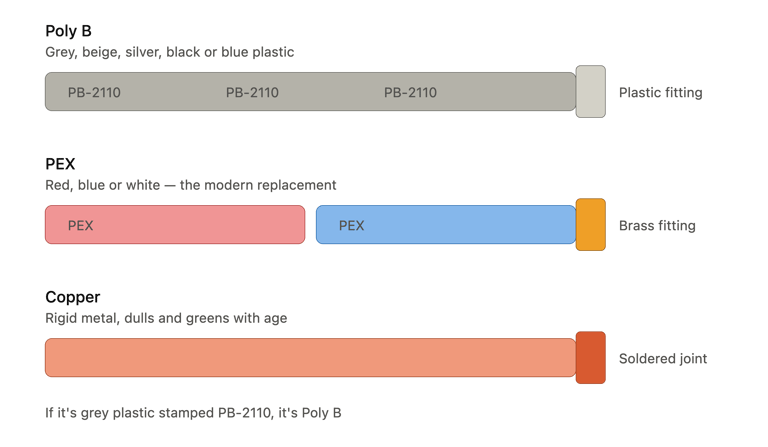
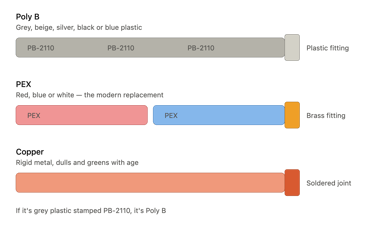
Grey plastic supply pipe — most commonly light grey, but it also came in beige, silver, black and blue
Stamped markings along the pipe reading PB-2110 or QEST
Plastic fittings at the joints — grey or white acetal, rather than brass or copper
Roughly the diameter of your finger, flexible, with a slightly dull surface
What Poly B looks like:
What it isn't:
Copper — obviously metal, rigid, goes green as it ages
PEX — also flexible plastic, but usually red, blue or white, and stamped PEX. This is the modern replacement, not the problem.
White PVC / ABS — that's your drain and waste piping, a completely different system
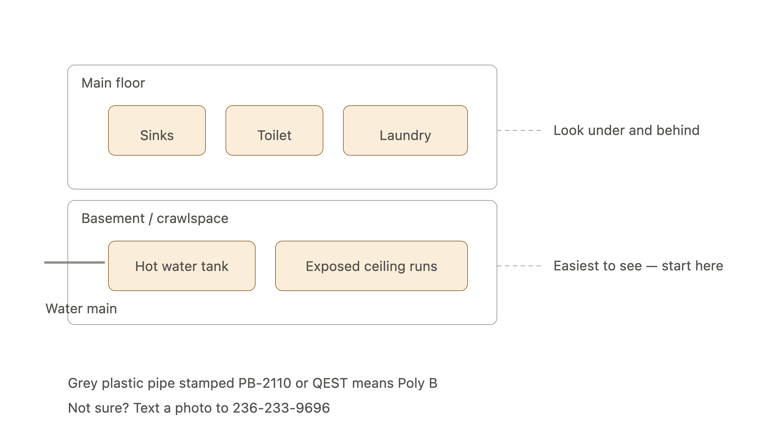
Where to look, in order of ease:
Under the kitchen and bathroom sinks
Behind or beside the toilet
At the hot water tank — supply lines in and out
Unfinished basement, crawlspace or garage ceiling runs
Where the water main enters the house
Can't tell?
Take a photo and text it to 236-233-9696.
We'll identify it for you at no charge and no obligation.
It takes us ten seconds and it saves you a week of wondering.
Why Poly B fails
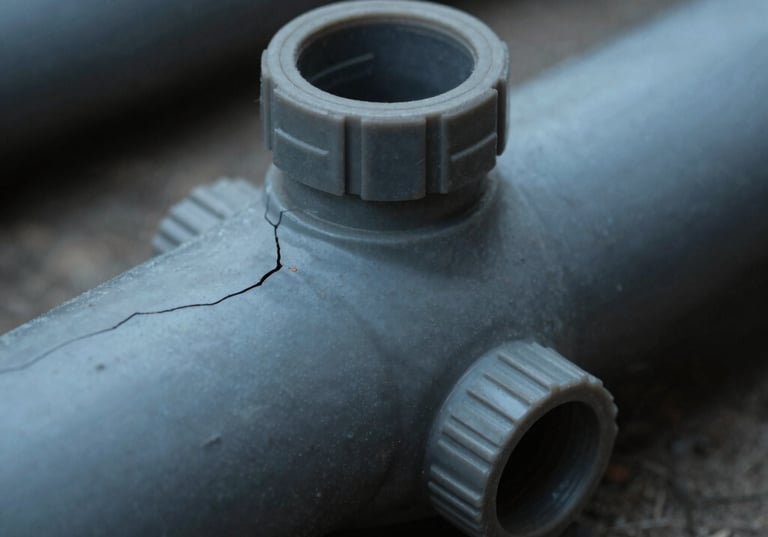
It's at the end of its service life.
Not approaching it — at it. Poly B installed in a 1991 Langley home has been in service for over thirty years, and failure rates climb sharply with age.
It isn't a failure you can see coming, which is the whole problem.
Chlorine attacks it from the inside.
The chlorine and other chemicals in municipal water react with the pipe wall over time, breaking the material down from within. It goes brittle. Micro-cracks form. The pipe looks fine right up until it doesn't.
The fittings were the weak point.
Early Poly B systems used plastic acetal fittings that weren't built for decades under constant pressure. They crack — and they crack behind drywall, where a slow leak becomes mould and rot long before anyone notices.
Manufacturers stopped producing it, and it is no longer approved for new plumbing installations in Canada.
Poly B and BC home insurance
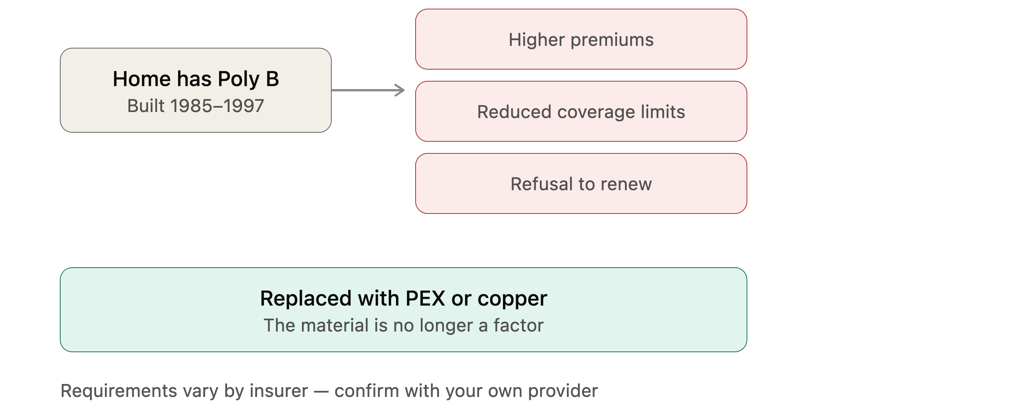
Many BC home insurers now treat Poly B as a high-risk material.
In practice, that can mean higher premiums, reduced coverage limits, refusal to renew, or refusal to write a policy at all until the piping is replaced.
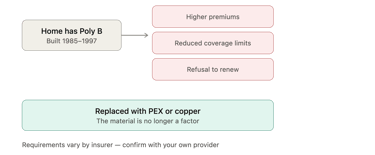
This is why most people call, so let's be direct.
Two things worth knowing before you call your broker:
1) Insurers generally won't pay to replace Poly B that hasn't failed.
Replacement sits with the homeowner. It's treated as a condition of coverage, not a claim — which catches a lot of people off guard.
2) Your policy is your policy.
Requirements differ between insurers and change over time. Ask your broker directly what your provider needs. We can't tell you what your insurer will decide — but we can tell you what you've got in your walls.
Selling the house?
The same issue surfaces during a buyer's inspection or when their insurer quotes. It's better to know now than three days before completion.
Poly B vs. PEX
vs. Copper
Poly B
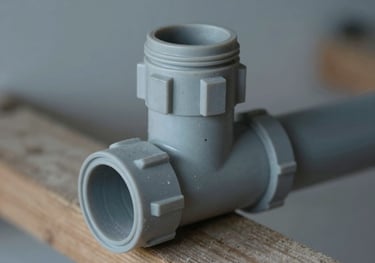
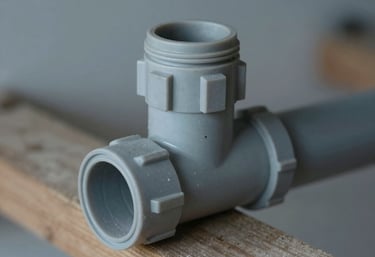
Installed in Langley homes from the mid-1980s through the late 1990s, Poly B is usually light grey plastic — though it also came in beige, silver, black and blue — stamped PB-2110 or QEST along its length.
It's flexible, joined with plastic acetal fittings, and no longer approved for new plumbing installations in Canada.
The problem isn't the pipe you can see; it's that chlorine in municipal water breaks the material down from the inside until it goes brittle, and those plastic fittings crack behind drywall where nobody notices until the ceiling stains.
Pex
Copper
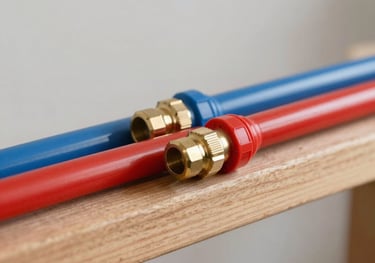
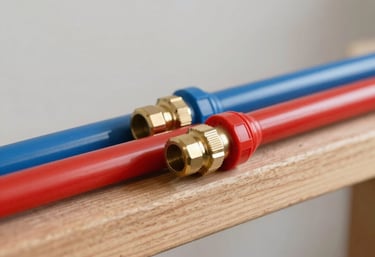
PEX is what most Langley repipes use today, and for most homes it's the right choice.
It's flexible plastic like Poly B, but a different material entirely — usually red, blue or white, stamped PEX, and joined with brass fittings.
Because it bends around corners, it needs far fewer joints behind your walls, and every joint you don't have is a joint that can't fail.
It handles cold better than copper, it's code-approved, and major manufacturers back it with long warranties.
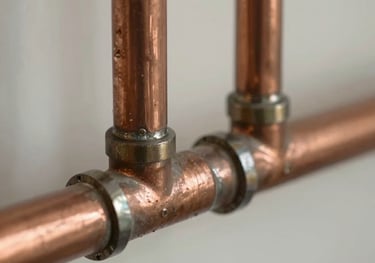
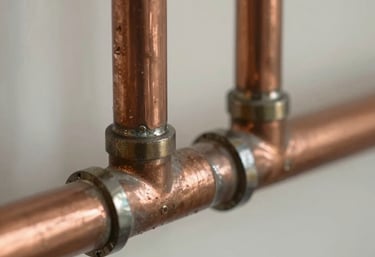
Copper has been in Canadian homes for decades and it's still a legitimate choice. It's rigid metal rather than plastic, joined with soldered fittings, and it dulls to a green patina as it ages.
It costs more in both material and labour because every bend is a fitting and every fitting is soldered by hand, and it will split if it freezes.
Some homeowners simply prefer it, and for exposed runs or certain layouts it's the better call.
Which one suits your house depends on the layout, the access and your budget. We'll tell you honestly if the cheaper option is the better one.
Common Questions
My house was built in 1999 — am I affected?
Probably not, but check anyway. Poly B was largely phased out by the late 1990s, and the transition wasn't a clean line. Look for grey pipe stamped PB-2110. Five minutes with a flashlight settles it.
Will PEX have the same problem in thirty years?
PEX is a different material with a different failure profile. It's the current code-approved standard and major manufacturers back it with long warranties. It is not Poly B.
Is Poly B illegal?
No. Existing Poly B isn't illegal and you're not required to remove it. It's simply no longer approved for new installations, and insurers have made their own decisions about it.
How do I know if it's already leaking?
Damp or discoloured drywall, a musty smell with no obvious source, unexplained jumps in your water bill, or reduced water pressure. Poly B failures often start as pinhole leaks inside walls — the damage shows up before the pipe does.
Can I just replace the section that failed?
For an active leak, a repair is sometimes the right immediate fix. But it doesn't change anything with your insurer, and the rest of the system is exactly as old as the piece that just gave out. Patching Poly B buys time; it doesn't solve it.
What does replacement cost?
It depends on the size of the home, the number of fixtures, and how accessible the runs are — there's no honest flat number. We'll look at your house and give you a written quote at no charge.
Plumbing Service Reviews
Read our client experiences with our plumbing services and solutions.
Not sure what's behind your walls?
Send us a photo of your pipes. We'll identify them for free — no obligation, no callout fee.
Plumblink Plumbing Inc. — Red Seal certified, insured, and based in Langley.
Plumbing Services
Emergency Plumbing
Kitchen & Bathroom Plumbing Langley
Backflow Repairs & Installation Langley
Repiping & Water Lines Langley
Poly B Replacement
Contact Us
Langley, BC, Canada
Plumblink Plumbing Inc.