24/7 emergency plumbing services: Text name, address and pictures to +1 (236) 233-9696

Poly B Home Insurance in Langley: What Homeowners Need to Know
Poly B home insurance in Langley is getting harder to keep. Here's why BC insurers are flagging grey poly pipe, what your renewal notice really means, and your options.
GENERAL PLUMBING
Plumblink Crew
7/18/20265 min read


Poly-B Home insurance in Langley: What Homeowners Need to Know
If you own a home in Langley built between 1985 and 1997, there's a good chance the water lines running through your walls are grey plastic pipe called polybutylene (Poly B) for short.
For years that was just a piece of trivia about your house, lately it's become a line item on your insurance renewal.
We're getting more calls from Langley homeowners who opened a renewal notice and found a surcharge, a new exclusion, or a deadline attached to their plumbing.
Most of them had no idea their pipe material was even on their insurer's radar. Here's what's actually going on, and what your options look like.
Why insurers started caring about grey pipe
Water damage is the most expensive claim category in Canadian home insurance, more costly overall than fire or theft. And Poly B has a documented failure pattern that makes insurers nervous.
The pipe itself degrades over time when exposed to chlorine and other chemicals in treated municipal water. The bigger issue is usually the fittings. Many Poly B systems were installed with plastic or crimped fittings that become brittle and let go without warning. There's no drip, no stain on the ceiling, no slow build-up. A fitting behind drywall fails and the water runs until somebody notices.
That's the part insurers dislike. A random plumbing failure is a risk they can price. A specific, identifiable material with a known failure curve starts looking less like a risk and more like a scheduled expense - and when that happens, coverage gets restricted.
The four responses you might get from your insurer
Not every carrier handles Poly B the same way, and BC insurers are all over the map on this. Broadly, there are four outcomes, and it's worth knowing which one you're looking at.
A premium surcharge. Your policy renews, but at a higher cost to reflect the elevated risk. Annoying, but you're still covered.
Continued coverage with a plumbing exclusion. This one catches people. The policy renews and looks completely normal, but water damage originating from plumbing failure is carved out. Homeowners often don't find out until they file a claim and it's denied. If you have Poly B and your renewal came back looking unchanged, read the exclusions section carefully.
Conditional renewal with a deadline. The insurer will keep covering you, but only if the Poly B is replaced by a specified date, with documentation. This is becoming the most common response and it's the one where the clock actually matters.
Non-renewal. The carrier declines to continue coverage at the end of the term. Finding a new policy on a home with confirmed Poly B, on short notice, is difficult and expensive.
None of this is universal - carriers differ, brokers differ, and a lot depends on your claims history and whether the system has been partially updated. If you're not sure which category you're in, your broker can tell you in one phone call.
How to check whether you actually have it
Before you worry about any of this, confirm what you've got. Poly B is usually easy to spot if you know where to look.
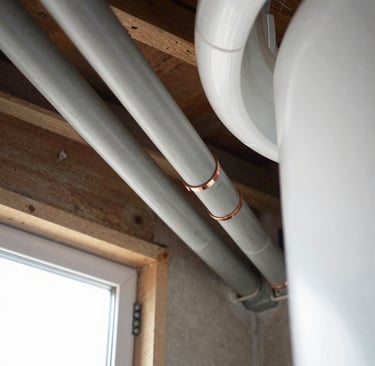
Check the exposed pipe at your hot water tank, under bathroom and kitchen sinks, and at the water shut-off valve. You're looking for flexible grey plastic pipe, roughly the diameter of a garden hose, often with copper or plastic crimp bands at the joints. Most of it is stamped with "PB2110" along the length.
A few things people mix it up with: grey ABS drain pipe is much larger and rigid, and modern PEX supply lines are usually white, red, or blue and noticeably stiffer. If it's grey, flexible, and carrying pressurized water, it's very likely Poly B.
The catch is that visible pipe is only part of the story. Plenty of Langley homes have had partial work done over the years - a bathroom reno here, a tank replacement there - so what you can see at the tank doesn't always reflect what's still behind the drywall. That's what an inspection is for.
Your options if you have it
Do nothing and monitor. If your insurer hasn't flagged it and the system is holding, this is a legitimate choice - as long as you know the risk you're carrying and you've confirmed your policy doesn't quietly exclude plumbing failure. While you monitor, watch for the early signs of a leak: damp spots, a water bill that climbs, or a drop in water pressure.
Partial replacement. Replacing the highest-risk runs, particularly the hot water lines near the tank where heat accelerates degradation. This buys time and reduces the odds of the worst-case failure, but it usually won't satisfy an insurer asking for documented full replacement.
Full replacement. Swapping the Poly B for PEX or copper throughout. This is what resolves the insurance question outright, and it's the only option that gets you a document your broker can act on. Homeowners frequently see premiums come back down after providing proof of replacement.
Which one makes sense depends on your renewal timeline, the age and condition of the system, and whether you're planning to sell. Poly B comes up in nearly every home inspection in the Fraser Valley, and buyers negotiate on it.
What replacement actually involves
The honest version: it's a real job, not a service call. A Poly B replacement in a Langley home means opening access points in walls and ceilings, running new PEX or copper, tying into fixtures, and pressure testing the finished system. Most homes can stay livable throughout, with water shut off for portions of the workday rather than the full duration.
What you should expect from whoever does the work is a walkthrough before anything starts, a clear scope of what's being replaced and what isn't, and paperwork at the end that your insurance broker can actually use. That last part matters more than people realize - a verbal "yeah it's all done" doesn't satisfy an underwriter.
Poly B isn't the only part of your plumbing where the paperwork matters as much as the work. If your property has an irrigation system, a boiler, or a commercial or strata connection, you may also be on the hook for annual backflow testing in Langley - another case where the certificate is the thing that counts.
If you're not sure where you stand
Two phone calls will resolve most of the uncertainty. Call your broker and ask directly how your carrier treats Poly B and whether your current policy has a plumbing exclusion. Then get eyes on the actual pipe so you know what you're dealing with.
Plumblink is a Red Seal certified plumbing company working throughout Langley, Willoughby, Walnut Grove, Murrayville, and the surrounding Fraser Valley. If you want your system checked and a straight answer on what's there, call us at 236-233-9696 or get in touch here. If it turns out you don't have Poly B, we'll tell you that and you'll have one less thing to think about.
This article is general information about plumbing materials, not insurance advice. Coverage terms vary by carrier and policy - talk to your broker about your specific situation.

Langley, BC, Canada
Plumblink Plumbing Inc.